
Introduction
When studying physics, we often learn about the famous laws of thermodynamics—the First, Second, and Third. However, the most fundamental law was actually formulated last. Known as the Zeroth Law of Thermodynamics, this principle establishes the very concept of temperature and makes all conventional thermometry possible. Without it, the rest of thermodynamics could not logically exist.
What is Thermal Equilibrium?
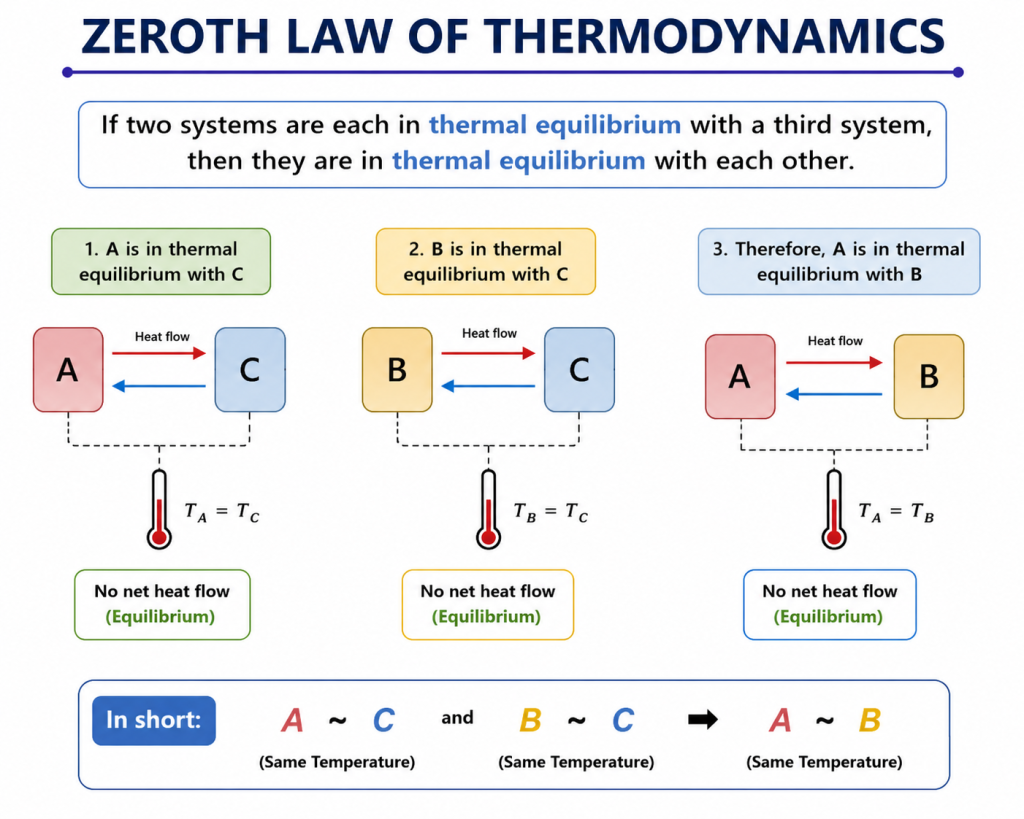
Before understanding the Zeroth Law, we must define thermal equilibrium. When two objects with different temperatures are brought into contact, heat flows from the hotter object to the cooler one. Eventually, they reach the same temperature and the net heat transfer stops. At this point, the system is in thermal equilibrium.
Defining the Zeroth Law of Thermodynamics
Formulated formally by physicist Ralph H. Fowler long after the first three laws were already named, the Zeroth Law states:“If two systems are each in thermal equilibrium with a third system, they are also in thermal equilibrium with each other.”Mathematically, if System A is in thermal equilibrium with System C (A = C), and System B is also in thermal equilibrium with System C (B = C), then System A and System B are in thermal equilibrium with each other (A = B).
Why is it Called the “Zeroth” Law?
The first, second, and third laws of thermodynamics had already been established and named by the time scientists realized that thermal equilibrium was a prerequisite baseline for all of them. Because this law logically precedes the First Law, scientists humorously and cleverly dubbed it the Zeroth Law rather than renumbering the entire established canon.
Real-World Applications: How Thermometers Work
The practical importance of the Zeroth Law is best understood through how we measure temperature:The Third System as a Thermometer: Imagine Object A is a cup of hot water, Object B is a cup of cold water, and Object C is a mercury or digital thermometer.Establishing Equivalence: If you place the thermometer (C) into the hot water (A) until it stabilizes, it reaches thermal equilibrium. Then, you place it into the cold water (B).Temperature Measurement: The Zeroth Law guarantees that because the thermometer can tell us if two separate systems share the same thermal state, we can use it to quantify temperature universally.
Conclusion
The Zeroth Law of Thermodynamics may sound simple, but it is the cornerstone of thermal physics. By establishing that thermal equilibrium is a transitive property, it provides the logical foundation for temperature measurement, thermometers, and thermodynamic scaling. Understanding this law is essential for anyone diving deep into the sciences, engineering, and energy systems.